
Housestories - the first four chapters
Bennett Tract Map (residential section)


 On
September 14, 2007, the New York State Office of Parks, Recreation and
Historic Preservation accepted the recommendation of the New York State
Board for Historic Preservation that the Abel Bennett Tract be added to
the State and National Registers of Historic Places. The Abel Bennett
Tract Historic District is described as an example of a late 19th and
early 20th Century residential subdivision. On February 19, 2008, the
Abel Bennett Tract was listed on the National Register of Historic
Places.
On
September 14, 2007, the New York State Office of Parks, Recreation and
Historic Preservation accepted the recommendation of the New York State
Board for Historic Preservation that the Abel Bennett Tract be added to
the State and National Registers of Historic Places. The Abel Bennett
Tract Historic District is described as an example of a late 19th and
early 20th Century residential subdivision. On February 19, 2008, the
Abel Bennett Tract was listed on the National Register of Historic
Places.
Histories and Housestories
Several years ago, interested West Side Neighborhood Association members formed an Historic Survey Committee to explore the architectural and historical past of the Abel Bennett Tract (or Location) area of the West Side. The residential section of the Location is bounded by Riverside Drive, Beethoven Street, Seminary Avenue, and portions of Chestnut Street and St. John Avenue. The complete Location also includes Recreation Park, which is bounded by Seminary Avenue, Schubert Street, Beethoven Street, and Laurel Avenue.
We knew that we'd have to research the dates and facts about the buildings located there, of course. But, what we actually discovered in our explorations, much to our pleasure and delight, were housestories! Through city directories, deed records and maps, the people who lived in these houses before us revealed tales about their lives, capturing our imaginations and drawing us into the past.
In the autumn of 2002 we were able to expand our research efforts with the help of graduate students from the Cornell University Historic Preservation Planning Workshop and its Director, Mary Joan Kevlin. Later, students were directed by Jeffery M. Chusid, Associate Professor of Historic Preservation. The students returned in 2003, 2004, and 2005, presenting results of their work, Housestories, at community forums. Some results of their efforts follow.
In the fall of 2005 the Association was awarded a Preserve New York grant, a program of the Preservation League of New York State and the New York State Council on the Arts, for $6,500. The funds will support the costs associated with the completion of a nomination to the State and National Registers of Historic Places for the Abel Bennett Location.
Abel Bennett
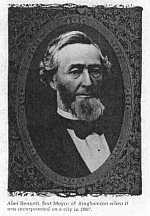 It all began with Abel Bennett,
born in Bennettsville, Chenango County, New York on November 16, 1818.
Bennett was an icon of business, civic leadership and philanthropy.
He made a fortune in the coal
industry in Pennsylvania as an owner of the Pennsylvania Coal Company.
His invention of the coal elevator increased mine productivity and raised
mine yields.
Bennett helped to develop areas around his coal mines
for residential ownership. These areas would later become parts of Scranton
and Pittston.
After his time with the Pennsylvania Coal Company, Bennett moved to New York City where he found great success as a partner in Lathrop, Luddington and Company, a dry goods business.
After hist first wife, Adelaide Johnson, died, he married Eugenia Lathrop, a niece of his partner.
It all began with Abel Bennett,
born in Bennettsville, Chenango County, New York on November 16, 1818.
Bennett was an icon of business, civic leadership and philanthropy.
He made a fortune in the coal
industry in Pennsylvania as an owner of the Pennsylvania Coal Company.
His invention of the coal elevator increased mine productivity and raised
mine yields.
Bennett helped to develop areas around his coal mines
for residential ownership. These areas would later become parts of Scranton
and Pittston.
After his time with the Pennsylvania Coal Company, Bennett moved to New York City where he found great success as a partner in Lathrop, Luddington and Company, a dry goods business.
After hist first wife, Adelaide Johnson, died, he married Eugenia Lathrop, a niece of his partner.
Upon moving to Binghamton in 1859, Bennett bought the Mackenzie Farm, known as the Grange, in what is now the West Side of Binghamton for $17,000. Within a short time he became an important figure in the city. As Binghamton’s first mayor after incorporation in 1867 he set the standard for governance. Bennett was the founding President of the First National Bank of Binghamton. He developed the "Bennett Block" on Washington Street in downtown Binghamton. It included the Bennett Hotel, designed by noted architect Isaac Perry, in 1877, and the Bennett Clothing Company. His philanthropy included the founding of the Susquehanna Valley Home. His income rose from approximately $50,000 in 1860 to $250,000 in 1870. Recreation Park, which we now associate with George F. Johnson, once bore his name as Bennett Park. In 1893 Binghamton became the first city in the state to run an electric streetcar line, rendering the horse-drawn trolleys nearly obsolete. By 1895, the rails of the West Side Street Railway Company extended up Leroy Street, with trolleys carrying people to the park.
In the late 1880’s, Abel Bennett’s health began to fail. Recognizing the impact of the Leroy Street trolley and seeing it heading west, Bennett platted his farm as a gridiron subdivision to be bounded by Riverside Drive, Beethoven Street, Seminary Avenue, and parts of St. John Avenue and Chestnut Street, and also including what is now Recreation Park. He sold 27 lots along Chestnut Street and Seminary Avenue, the eastern and northern edges of his farm between 1882 and 1887, before his death in 1889. Bennett directed his executors, son Frederick Stanley Bennett and son-in-law Stephen C. Millard, to sell the remaining lots to preserve the family fortune.
Development of the Location
The city at that time had a population of about 33,000. Homes began to go up on Leroy Street west of Chestnut Street as early as 1893 and continued throughout the decade into the early 1900's. Few buildings appeared on parallel streets such as Lathrop Avenue until well into the 20th Century. The Bennett farm, renamed the Bennett Location, quickly became a major westward expansion of the city, offering new residents a quiet suburban lifestyle away from the bustle of downtown Binghamton. Development was facilitated by the conversion of the horse-drawn trolley car track, laid down in 1887 on Leroy Street, to an electrified trolley in 1893. The trolley line bisected the Location east to west and provided easy access to new residents. The Location was about to become one of the early trolley suburbs in the state.
Building continued west on Leroy and then on parallel streets throughout the first two decades of the 20th century until the Location was fully developed into a neighborhood of nearly 570 period homes. Houses built in the Location exemplify domestic architectural styles of the period. The multi-gabled rooflines of the Queen Anne Style and attic dormers of the Hipped-Roof Cottage Style predominate; multi-textured Shingle Style, colonnaded Colonial Revival Style and Arts-and-Crafts Style are also represented. Some are stately in their faithful adherence to the attributes of one style. Others are eclectic. The houses in the neighborhood have retained a high level of historic integrity and contribute to an overall sense of a highly intact trolley suburb.
Local architects and builders contributed their considerable talents to houses in the Location. Sanford O. Lacey, one of a noted family of architects, lived at 107 Leroy Street in 1898 and less than a decade later at 23 Lathrop Avenue. He designed several Shingle Style houses in the Location. Norman Millard, grandson of Abel Bennett, built numerous homes in the Hipped-Roof Cottage Style that came to be commonly known as Millard Houses. In 1902 the shops and yards of builders Mitchell and Stever occupied what is now 44-48 Lathrop Avenue. Mr. Mitchell's home at the time was at 123 Leroy Street close behind them.
It appears that rental accommodations were also available. Cigar makers, dressmakers, harness makers, and horse trainers, all took rooms in the neighborhood, often sharing a home with the owners themselves.
Many people who lived in the Location contributed in very substantive ways to the civic, business and political vitality of the community. Nevertheless, early homeowners were as diverse a group in occupation as we are today. Bookkeepers and bankers, carpenters and contractors, dressmakers and doctors, linotype operators and lawyers - they together built a new neighborhood in the Location and added strength and breadth to the development of Binghamton.
The Seminary
Prior to the development of the Abel Bennett Location, there was only one large imposing structure on the West Side of Binghamton - the Susquehanna Seminary, which later became St. Mary’s Orphans Home. The Home was built in 1853 as the Susquehanna Seminary by the Wyoming Conference of the Methodist Church. The Seminary closed due to lack of support in 1858.
The building remained unoccupied until 1867 when it became the property of the state and was fitted to serve as a school for the blind; however, it was never used for that purpose. The Susquehanna Valley Home temporarily resided in the building until it moved to its permanent location in Griffith Mansion at 153 Conklin Avenue in 1871.
Then Place College for Advanced Education of Young Ladies was established at the site. Place College closed shortly thereafter, and in 1872 Dean Smith established Dean College, a school for women. The college struggled with debt until Smith’s death in 1877. The Reverend Robert Patterson took over management of the school and renamed it Binghamton Ladies College. The school closed in 1880.
In 1881, a local priest, Father Hourigan, recognized the need for a larger facility for orphaned children than the small building then used at Oak and Leroy Streets. He looked favorably on the large brick building of 100-plus rooms and the eight acres of land at the Seminary site. In 1881 the Trustees of St. Patrick’s Church purchased the property from Abel Bennett for $23,000. It is uncertain when Abel Bennett purchased the property. However, because he was involved with the establishment of the Susquehanna Valley Home, it is possible he purchased it then. St. Mary’s Orphans Home opened with 40 boys and 30 girls.
The nuns from the Sisters of St. Joseph of Carondolet oversaw the operations of the orphanage. It had on-site education through the 8th grade, after which the children would move on to St. Patrick’s Academy. The site had campus-like grounds with a basketball court and swimming pool. The children would walk to the park for other recreational activities. Boys and girls were housed on separate sides of the building with a chapel, classrooms and parlor at the center of the building. The only time boys and girls were together was during class. They even dined in separate cafeterias until the population declined.
At its peak during the Great Depression of the 1930’s approximately 300 children lived at St. Mary’s Orphanage. Not all the children were orphans; some were children from families with destitute, abusive or alcoholic parents. By 1960, there were fewer than 30 foster care children residing in the orphanage. In May 1961, the Roman Catholic Diocese of Syracuse purchased the building from the Sisters of St. Joseph for $100,000 to make way for the new Seton Catholic Central High School. The 108-year old Orphanage building was demolished.
In 1996 there was a reunion for those who had lived in St. Mary’s Orphanage. Many attended to reminisce and share fond memories of their stay there. Proceeds from the reunion were dedicated to a plaque honoring the Sisters of St. Joseph and commemorating St. Mary.
The Bennett Farmstead
Abel Bennett’s farmstead was located across the street to the south of the Seminary site. His house faced Chestnut Street, but did not acquire the address of 75 Chestnut until the late 19th Century. The Bennett house sat where 6 and 8 Davis Street are now located.
 The house was large and of Italianate style. It’s possible that its
design was taken from the Modern Architect pattern book. First published
in book form in 1852, the pattern book was wildly popular - three more
editions were published by 1873. The book was written by the prominent
Philadelphia architect, Samuel Sloan. Sloan may have been the source for
the design of the Seminary across the street. Sloan designs and the
Italianate style in general, were popular in the mid 19th century
when the Bennett house was built. The Italianate style is characterized
by decorated eave brackets, a projecting front tower, and tall and narrow
arched windows.
The house was large and of Italianate style. It’s possible that its
design was taken from the Modern Architect pattern book. First published
in book form in 1852, the pattern book was wildly popular - three more
editions were published by 1873. The book was written by the prominent
Philadelphia architect, Samuel Sloan. Sloan may have been the source for
the design of the Seminary across the street. Sloan designs and the
Italianate style in general, were popular in the mid 19th century
when the Bennett house was built. The Italianate style is characterized
by decorated eave brackets, a projecting front tower, and tall and narrow
arched windows.
Abel Bennett occupied the house from 1859 until his death in 1889. In his will Bennett left the estate to his son Fred, who became the primary resident of the house before relocating to Pennsylvania at the turn of the century. The house stood vacant for only a couple of years before it was demolished in 1912.
A complex of other buildings existed on the farmstead. They were located approximately across from what is now the intersection of Davis Street and Millard Avenue. There were barns and stables, as well as two grape houses, which were long stone structures to the south of the house.
The only buildings surviving from the original Bennett farmstead are three original tenant houses facing north on Seminary Avenue. Two of the houses appear on an 1876 Binghamton Atlas map, and all three had been built by the time the 1885 Atlas map was drawn.
In the late 1880’s, members of the McGowan family appear as the first identified tenants of the houses. Binghamton City directories show that the McGowan men moved in and out of the houses for over two decades, sharing occupancy with only a few other tenants, including Henry Davis and Joseph Murphy. The McGowan’s have been identified as horse handlers, drivers, woodworkers, gardeners, and farmers. John H. McGowan, the most consistent tenant of the houses in the late 19th century, is titled as the Foreman for the Bennett Estate. The houses were eventually bought by members of the McGowan family and by Joseph Murphy shortly after the turn of the century.
The tenant houses were originally numbered 75a and 75b as sub-properties of Abel Bennett’s house on 75 Chestnut Street before becoming individually numbered properties in the early 20th century. The houses were renumbered two more times before acquiring their present addresses at 87, 89, and 93 Seminary Avenue. They are gothic revival open gable cottages and have had only minor exterior changes since the 19th century. In terms of the development of the neighborhood, the houses are the oldest remaining structures in the Abel Bennett Subdivision.
Historic Districts
Our ultimate goal is to use this research to nominate the Abel Bennett Location for recognition as a state and national historic district.
A state and national district means the district would be placed on the State and National Registers of Historic Places. The National Register is maintained by the National Park Service, Department of the Interior, and is the nation's official list of districts, buildings, sites structures and objects significant in American history, architecture, archeology, engineering, and culture. The criteria for evaluation of potential entries in the Register are:
- that they are associated with events that have made a significant contribution to the broad patterns of our history; or
- that they are associated with the lives of significant persons in our past; or
- that they embody the distinctive characteristics of a type, period, or method of construction, or that represent the work of a master, or that possess high artistic values, or that represent a significant and distinguishable entity whose components may lack individual distinction; or
- that they have yielded, or may be likely to yield, information important in history or prehistory.
The pursuit of a state-national district will take considerable time and effort but will be well worth it in greater incentive to rehabilitate historic properties and increased pride in our entire neighborhood. Presently, federal law allows owners of commercial property to take a 20% federal income tax credit for the cost of substantial rehabilitation. There are currently bills under consideration at both the State and Federal level that would provide the same tax incentive to residential owners. In addition, designated properties may take advantage of a city tax abatement program in which the overall assessment is adjusted gradually over a 10-year period after substantial improvements are made to a property. There are no restrictions placed on owners of state and nationally registered historic properties.
If you have any information about the "housestory" of a home in the proposed district we need it and would love to have it! Please do not hesitate to e-mail Sandra Haining with comments or questions.
© Copyright WSNA, Inc. 2001, 2006. All rights reserved.